 Racing Basics
The Going Explained: How Ground Conditions Decide Races
Soft, good to firm, yielding, heavy: the going shapes every result in British and Irish racing, yet it is the variable form students most often skim. Here is what the official descriptions mean, how clerks and the GoingStick measure them, and how to read a horse's ground record properly.
In July 2016, on quick summer ground at Newmarket, Limato won the July Cup — one of the championship sprints of the British season — in a shade under seventy seconds, skimming over the turf with the long, low stride of a horse doing exactly what he was made for. Henry Candy's gelding was, on his day, among the fastest horses in Europe. But his day came with a forecast attached. When rain got into the ground the brilliance dimmed, and his rider reckoned that soft going simply made him a different horse. Limato never changed from one month to the next. The ground beneath him did.
Racing has a word for the state of that ground: the going. It is declared before every meeting, printed at the top of every racecard, and skimmed past by plenty of readers on their way down to the names. Yet it is probably the most underestimated variable in British and Irish racing — the weather system of form. Ability does not vanish when conditions change, but the ground decides how much of it we are allowed to see, and a form book read without reference to the going is a map without contours.
This guide covers what the official descriptions actually mean, who decides them and how, why soft ground rewrites results so completely, and how to fold the ground into the way you read a race.
The official scale, from firm to heavy
The going is declared by the clerk of the course, the racecourse official responsible for preparing and describing the track. In Britain the everyday turf scale runs, from fastest to slowest:
- Firm — dry, fast ground with little give underfoot.
- Good to firm — a touch of ease in otherwise quick ground; much of the summer flat season lives here.
- Good — the benchmark: enough moisture to cushion the stride without slowing it.
- Good to soft — noticeably more give; times begin to slow and stamina starts to matter.
- Soft — wet, holding ground that demands a real effort at every stride.
- Heavy — saturated, energy-sapping ground, the most searching test the sport stages.
A "hard" description survives in the rulebook but has all but vanished in the era of routine watering. Ireland adds a grade of its own: yielding, which sits roughly where Britain's good to soft does, with hybrids such as good to yielding and yielding to soft. Clerks also blend descriptions to reflect a patchwork course — "good, good to soft in places" tells you the ground varies strip by strip. All-weather tracks carry a parallel vocabulary — fast, standard to fast, standard, standard to slow and slow — though the artificial surfaces spend most of their lives at standard.
How the ground is measured
The traditional instrument is the clerk's own legs. On a raceday the first walk of the course happens around dawn — six in the morning at a summer fixture — with boots pressing into the turf every few strides and an updated report reaching trainers and the press by breakfast. That craft still matters, but since the 2000s it has been paired with a machine: the GoingStick, developed by TurfTrax with soil scientists at Cranfield University after the sport's regulator asked for an objective measure of ground conditions.
The GoingStick records two forces. Pushed vertically into the turf, it measures penetration — the resistance the ground offers a descending hoof. Levered back to 45 degrees, it measures shear — the grip the turf gives a horse as it loads a leg and pushes off. Readings are taken at intervals around the course and averaged into a single figure on a scale running to 15, where higher means firmer. British turf courses have been required to publish a reading alongside the official description since the late 2000s, at declaration time and again on the morning of racing.
One caveat: the numbers are course-specific. "Good" on Goodwood's free-draining chalk downland is not the same surface as "good" on a low-lying clay track that holds every shower, so a GoingStick figure is best compared with the same course's own history rather than a neighbour's. Rainfall logs and irrigation complete the picture — in dry spells clerks water the track to stop it turning dangerously quick, which is why midsummer reports often carry the note "watered".
Why ground rewrites results
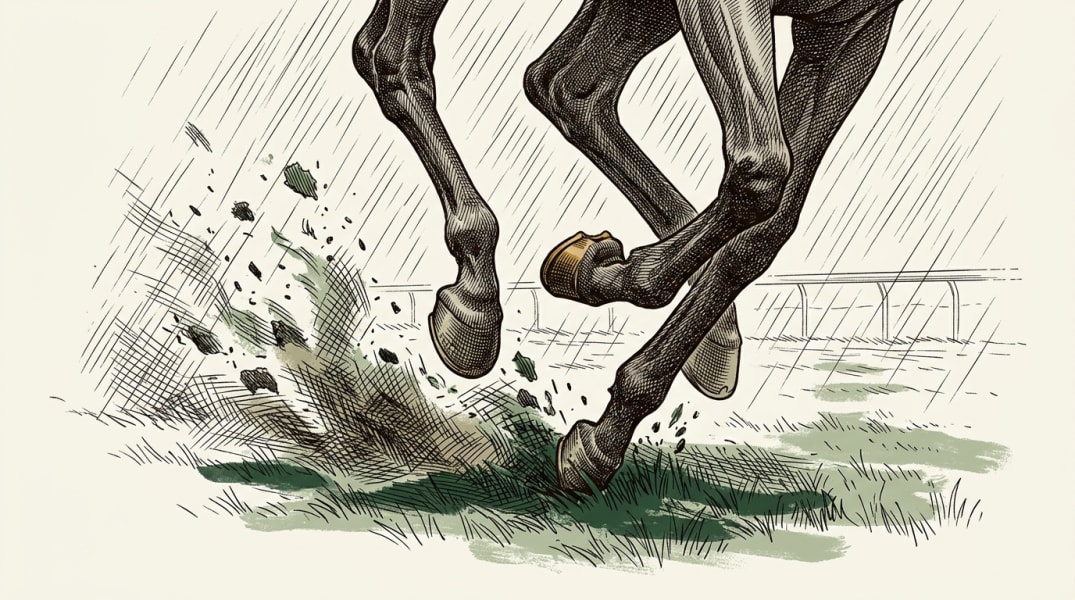
Start with the horse itself. Watch a field canter to the start and you will notice different actions. Some horses are daisy-cutters, moving with a long, low, skimming stride that barely lifts the knee — a beautifully efficient way of covering fast ground. Others go with a rounder, higher knee action that picks each foot up and out of the turf. On quick ground the daisy-cutter's economy is decisive; on soft, that same low stride slips and labours while the round action loses far less. The going does not simply slow horses down. It slows them down unevenly, and that is why it reorders finishes rather than merely delaying them.
The physics is unforgiving. Soft ground gives way beneath the hoof, so part of every stride's energy drains into the turf; strides shorten, the cost of each one rises, and a race becomes far more tiring than its bare distance suggests. Heavy ground makes stamina decisive even over sprint trips, and it blunts the weapon that wins most good races — the finishing kick.
The record book shows how violent the effect is. In 2012 the July Cup was run, remarkably, on heavy ground in mid-July, and Richard Fahey's Mayson — a mud-loving outsider in the market — made every yard to win by five lengths in 1min 15.90sec, the slowest renewal in a generation. Four years later, Limato needed just 1min 9.97sec over the same six furlongs. Nearly six seconds separated two runnings of the same race at the same course: a gulf no horse alive could bridge on ability alone.
For the blunted kick, take the 2019 Prix de l'Arc de Triomphe. Enable arrived at Longchamp chasing an unprecedented third win in Europe's richest race and hit the front early in the straight — but overnight rain had turned the ground testing, and Waldgeist, relishing conditions she merely endured, wore her down in the closing strides. John Gosden's verdict was that on soft ground his mare could not produce "the same explosive turn of foot"; she was, in the oldest racing phrase of all, outstayed.
The going does not change how good a horse is; it changes which of its gifts are allowed to count.
Reading a horse's ground record
All of this becomes practical the moment you open a racecard, because the evidence sits in the form lines.
The going string
Each past run shown on a card carries the going it was run on, usually abbreviated — GF for good to firm, Hvy for heavy and so on. Read down that column before you read anything else. A horse whose three career wins all came on soft or heavy is telling you something; so is one whose form figures collapse whenever the word "soft" appears. Our guide to reading a racecard shows where these details live and how the rest of the card fits around them.
Breeding hints
Lightly raced horses may never have seen testing ground, so breeding fills the gap. Certain sires stamp their stock with a going tendency, and analysts publish per-sire going records for precisely this reason: Pivotal's offspring earned a reputation for relishing soft conditions, while Montjeu's stock — famed for their rounder knee action — were widely held to improve for cut in the ground, a lean that runs through much of the Sadler's Wells line. Treat these as hints rather than verdicts, but on a first run into deep ground a hint is more than the bare form offers.
The C&D trap
Cards flag a previous course-and-distance winner with "C&D", and it is a genuinely useful signal — course fit and trip fit both matter. The trap is that those letters say nothing about the ground that day. A course-and-distance win earned on firm going is close to worthless evidence on heavy: same track, same trip, different sport. Check the conditions behind every course credential, and listen to trainers' comments too — stables usually know a horse's preference long before the form book proves it.
The going calendar
Ground follows the seasons, and so does form. Spring is the drying season, when winter-soaked tracks firm up unevenly and the going can swing from heavy to good within a fortnight. High summer brings quick ground and the watering can. Autumn brings the rain back — and with it the mud-lovers who have spent months waiting. Winter jumping is routinely staged on soft and heavy, where stamina and attitude rule.
The most disruptive weather is the unseasonable kind, because it ambushes meetings built on an expectation. Mayson's heavy-ground July Cup is one example; Goodwood in 2023 was a starker one. Rain repeatedly swept the Downs that week — the Sussex Stakes was run on soft ground — and the final day deteriorated so badly that after four races the card was abandoned, an area of false ground (turf that gives way without warning) having appeared on the bottom bend. That happened in August, at one of the best-draining tracks in the country. When a summer festival turns soft, every plan on the card is rewritten — part of what makes those weeks such rewarding study, as our tour from Glorious Goodwood to the Ebor shows.
When the ground moves on the day
The going is a forecast as much as a fact. Overnight rain can turn a card declared on good into a soft-ground event; a drying wind and strong sun can pull it the other way by mid-afternoon. Clerks walk at dawn, publish an update by breakfast and must announce any change during the meeting itself — that Goodwood Saturday began as soft and was officially changed to heavy after the opening race.
Late shifts reshape the field as well as the form. Flat runners are declared two days before racing, and the rules allow a horse to come out as a non-runner where the raceday going differs from what its trainer could reasonably have expected at declaration time. A wet night can therefore flood the next afternoon with withdrawals, and stewards keep a close eye on horses repeatedly taken out for going reasons.
For the form student, a late shift is opportunity dressed as chaos. The form book re-ranks itself the moment the rain arrives: the obvious favourite may be unproven in the mud, while an overlooked runner suddenly owns the only heavy-ground win in the race. Market prices do not always catch up at once, and reading the morning going update properly — knowing whose record fits the new conditions — is one of the simplest edges available to anyone willing to look for it.
Putting numbers on the going
The first move is to sort any horse's record by conditions: win rate and top-3 finish rate on quick ground (firm and good to firm), on a middle band (good and good to soft), and on slow ground (soft and heavy). Small samples deserve humility — two runs on heavy prove very little — but clusters of evidence across a career rarely lie, and genuine versatility is worth knowing about too.
This is where modern tools earn their keep. On Sportily, Race Lens lets you make going one filter among dozens — say, front-runners on soft or worse at a particular course — and test the angle against years of history before trusting it. And because raw times are hostage to conditions, Sportily Speed Figures adjust every performance for the day's ground through track variants, so a horse slogging home in a slow time on heavy still earns the figure its effort deserved. Our explainer on speed figures shows why time only becomes meaningful once the ground has been accounted for.
None of it needs a database to begin, though. The going is printed at the top of every card, free to anyone who glances at it. Read it first rather than last, ask of each horse whether it has ever shown its best on ground like today's, and you will already understand the afternoon more deeply than most of the crowd around you. The ground is always talking; form students simply learn to listen.
Sportily is a statistical research platform for racing fans. It does not provide betting advice, and past results never guarantee future performance.
Ready to get started?
Every racecard on Sportily shows the day's official going beside each runner's ground record, so you can see at a glance who improves when the rain arrives. Create a free account and open today's cards to put the ground to work.
Get started →Next steps
Carry on with Speed Figures Explained to see how time and ground combine, then How to Read a Racecard for the full anatomy of a card.