 Racecourses
From Glorious Goodwood to the Ebor: Racing's Golden Summer
Late summer gives British flat racing its two greatest festivals: five days on the Sussex Downs from 28 July, then four on York's Knavesmire from 19 August. A guide to the tracks, the races, the contrasting demands they make, and how a form student reads a festival week differently.
The flat season has a shape, and everybody feels it even if nobody quite draws it. Spring belongs to the Classics and their arguments about who the best three-year-old might be. June belongs to Royal Ascot, where the sport dresses up and the whole world sends horses. Then comes a quieter stretch of July, a month of gathering evidence, before the season delivers its two finest weeks.
From Tuesday 28 July to Saturday 1 August 2026, the Qatar Goodwood Festival occupies five days on the Sussex Downs. Nineteen days later, from Wednesday 19 to Saturday 22 August, York's Ebor Festival takes over the Knavesmire for four. Between them they stage the best middle-distance race in the world, the fastest sprint in Europe, a mile championship with a century of history behind it, and the two most ferociously competitive handicaps in the calendar.
They are also, as racecourses, near-opposites — and that contrast is the most interesting thing about them. What a horse needs at Goodwood is not what a horse needs at York, and knowing the difference is the beginning of reading either meeting properly.
What July is for
The weeks between Royal Ascot and the Downs look, on a fixture list, like filler. They are nothing of the kind. July is when the season's questions are posed and the answers rehearsed: the July Cup at Newmarket sorts the sprinters, the Eclipse at Sandown brings three-year-olds against their elders for the first time at the top level, and the King George VI and Queen Elizabeth Stakes at Ascot gathers the best middle-distance horses in Europe.
For anyone reading form, the value of July is that it generates the evidence the festivals will test. A three-year-old who runs well against older horses in early July is a different proposition by August, when the weight-for-age allowance has shrunk and the excuse has gone. A sprinter who wins on quick ground at Newmarket has told you something the moment rain arrives on the Downs. Watch July properly and the festivals stop being isolated spectacles; they become the closing arguments in a case that has been building for a month.
Goodwood: beautiful and brutal
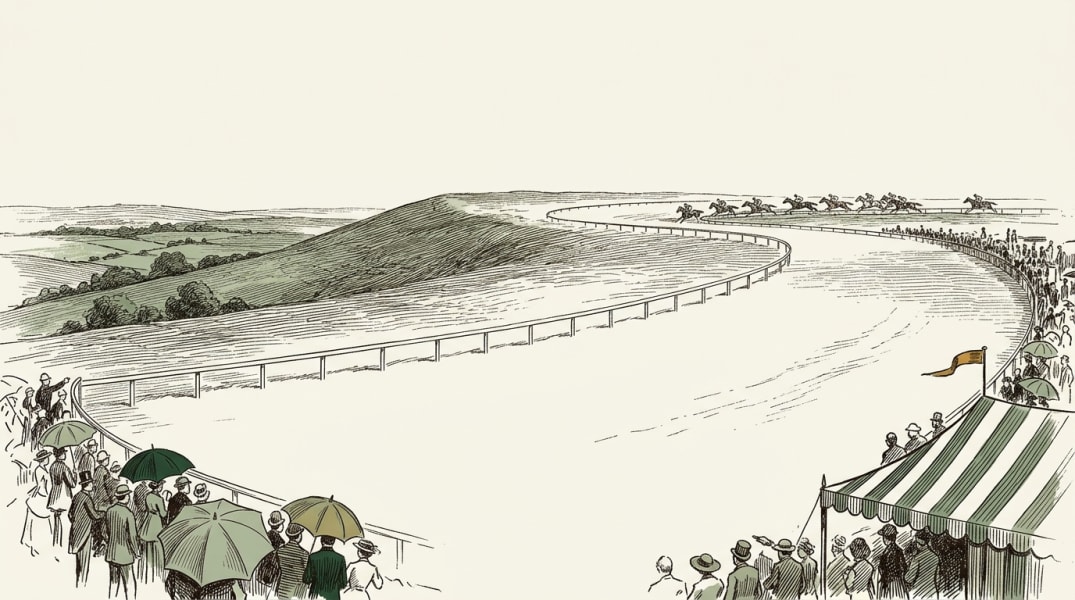
Goodwood sits high on the South Downs, a track laid across the shoulder of a hill with the Sussex countryside falling away beneath it and, on a clear day, the sea visible in the distance. It is routinely called the most beautiful racecourse in the world, and on a July afternoon with the marquees up and the downland shimmering, the claim is hard to argue with. Jockeys use a second adjective as often as the first: brutal.
The reason is the shape of the place. Goodwood is a switchback — it climbs, falls, bends and cambers, and it does these things in combinations found nowhere else. A field runs downhill into a sweeping left-handed turn, and the horses on the outside are trying to hold a line across a slope while travelling fastest. Balance matters more here than raw ability. A big, long-striding galloper that would win comfortably on a flat, wide track can find itself unable to change legs, unable to hold the bend, and beaten by a smaller, handier rival with half its talent.
The consequences are visible in the results, and in the language people use afterwards. Goodwood produces more hard-luck stories than any other major British track: horses that met trouble on the bend, that were forced wide and never recovered, that ran out of racing room in a short straight. Some of that is chance. Much of it is the course, doing precisely what its topography promises.
The five days
The festival unfolds as a sequence of championships, each with its own constituency.
- The Al Shaqab Goodwood Cup, over two miles and worth £500,000, opens the week and settles the staying division — the horses bred and trained to gallop further than anyone else, and beloved by the crowd for exactly that reason.
- The Visit Qatar Sussex Stakes, a mile, is the week's championship race and carries a £1 million fund. It has a nickname, the Duel on the Downs, earned in 2011 when Frankel and Canford Cliffs — the best older miler in Europe — met in a two-horse race that had been anticipated for months. Frankel won it, and won the race again in 2012.
- The Qatar Nassau Stakes, over a mile and a quarter and worth £600,000, is the summer's championship for fillies and mares.
- The King George Qatar Stakes is the sprint: five furlongs, a little over a minute, down the Goodwood hill.
- The Coral Stewards' Cup closes the week on Saturday — a full field of sprinters over six furlongs, one of the most valuable and competitive handicaps of the season, and a race in which the field habitually splits into groups, each choosing its own strip of ground.
York: the fair test
The Knavesmire is the antidote to the Downs. York's track is wide, level and generous — a broad expanse of turf on common land south of the city, with long straights, sweeping turns and room for every horse to be given a chance. If Goodwood asks whether a horse can cope, York asks the simpler and more searching question: which of you is best?
That fairness is why York form travels so well. When a horse wins on the Knavesmire, few excuses are available to the beaten runners, and the result tends to be corroborated later in the season. It is also why the meeting attracts international raiders, and why the Juddmonte International has such standing: it is a Group 1 over a mile and a quarter on a course that hides nothing.
The four days
Wednesday belongs to the Juddmonte International Stakes, which has a fair claim to being the best race in the world — it was ranked as such by the International Federation of Horseracing Authorities on the strength of the 2024 running. Frankel's demolition of a top-class field in 2012 remains the performance by which the race is measured. In 2026 it has an unusually clean storyline: Ombudsman, the Godolphin five-year-old, is entered to defend the title he won a year ago.
Thursday is Ladies' Day and the Pertemps Network Yorkshire Oaks, regularly the highest-rated race in Europe for fillies and mares. Friday brings the Coolmore Wootton Bassett Nunthorpe, five furlongs of pure speed and frequently the highest-rated sprint of its kind anywhere in the world — a race over in under a minute in which two-year-olds are permitted to take on hardened older sprinters, and occasionally beat them.
Saturday belongs to the race that names the meeting: the Ebor Handicap, a mile and six furlongs, Europe's richest flat handicap, and in 2019 the first British handicap to carry a £1 million fund. Twenty-odd horses, weights assigned by the official handicapper so that in theory they finish together, and a stampede up the Knavesmire straight to prove that theory wrong. If the machinery behind those weights is a mystery, our guide to how handicaps really work unpacks it.
Goodwood asks a horse what it can survive; York asks it what it can do. The same animal can answer the two questions very differently.
How a form student reads a festival week
Festival racing is not ordinary racing with better hats. Four things change, and each changes how the form should be read.
Fields get bigger. Prize funds draw runners, and a twenty-runner handicap behaves nothing like an eight-runner one. Traffic problems multiply, the pace is genuinely strong, and both the draw and the run style stop being footnotes. In the big sprint handicaps particularly, where a field spreads across the width of a track, stall position becomes one of the loudest facts on the card — see our guides to draw bias and sectional times and pace.
Course specialists emerge. Because Goodwood makes such particular demands, horses that have already proved they handle it deserve credit that a generic rating will not give them. A course record at a track this idiosyncratic is evidence about temperament and balance, not just ability.
The ground becomes a story. Late July and August ground can be quick, watered, or — as Goodwood discovered in 2023, when a day was abandoned after four races — thoroughly soft. Every plan on the card is written in pencil until the going is declared, and a soft-ground renewal of a summer festival reorders the whole meeting.
Three-year-olds meet their elders. Much of the drama of late summer comes from the younger generation, seasoned by the Classics, taking on established older horses under the weight-for-age allowance. It is the moment the season's arguments get settled.
Watching, and being there
Both meetings are broadcast free-to-air on ITV, which means the best racing of the summer reaches anyone with a television. Goodwood's five days build steadily to the Saturday; York's four are front-loaded, with the Juddmonte on the opening afternoon.
Going in person is a different pleasure at each. Goodwood is a hill, a view and a long walk; the racing happens across the downland and the horses appear out of the landscape. York is a city racecourse with a picnic culture — families on the Knavesmire grass, hampers open, the whole of Yorkshire apparently in attendance. Neither experience requires you to understand a single form figure to enjoy it.
But the form is there, and these are the weeks it repays most. Nineteen days separate the last race on the Downs from the first on the Knavesmire, and in that gap the shape of the season resolves: who stays, who sprints, which three-year-old has grown into a champion, which handicapper has been waiting all year for one afternoon. Then the evenings shorten, the ground softens, and the sport turns towards autumn — but not yet. For four weeks in late summer, British flat racing is exactly as good as it gets.
Sportily is a statistical research platform for racing fans. It does not provide betting advice, and past results never guarantee future performance.
Ready to get started?
Follow both festivals with the model alongside you: SmartPicks flags the selections it rates each day, with a transparent record of how they have fared. Create a free Sportily account before the Downs come alive on 28 July.
Get started →Next steps
Before the big sprint handicaps, read Draw Bias to see how stall position shapes a twenty-runner field, then Sectional Times and Pace for how those races are really won.